
The Playbook for Transitioning to Self-Funded Health Plans in New England
 For decades, most New England employers relied heavily on traditional fully insured health plans. Annual renewal cycles were more predictable, risk was fully transferred to carriers, and administrative overhead remained manageably low.
Today, many New England employers face a different reality due to fundamental shifts. Less favorable medical loss ratios, increased specialty pharmacy pricing, and overall healthcare inflation have substantially impacted this traditional model. As employers navigate major premium increases that operate independently of their actual workforce claims experience, many benefits leaders across New England are evaluating alternative healthcare financing models.
According to the 2025 KFF Employer Health Benefits Survey, over 67% of covered workers nationwide are now enrolled in self-funded health insurance arrangements. Despite this national shift toward self-funded plans, adoption in New England has historically trailed the national rate, averaging approximately 51%. KFF and Medical Expenditure Panel Survey data show that Vermont, New Hampshire, and Connecticut exceed the regional average, while Maine, Massachusetts, and Rhode Island fall notably below it.
For organizations contemplating this shift, transition to self-funded health plans is not merely an insurance transaction; it offers a long-term risk management strategy. This introduction will help New England employers and brokers understand the core mechanics, structural frameworks, and operational steps to self-funded health plans. There is an action plan at the end, so let’s dive in.
Why Employers Are Re-Evaluating Fully Insured Models
The fundamental shifts described above are driving fully insured employers to re-evaluate this strategy and consider alternatives.
When evaluating fully insured versus self-funded plans, the fundamental difference lies in the risk allocation and data ownership. In a fully insured plan, an employer pays a fixed premium to a health plan carrier. The carrier absorbs financial risk for high-cost claims, but in exchange, retains all plan margins, applies carrier-specific underwriting trends, and restricts access to detailed claims utilization data.
In other words, an employer is not involved in optimizing the plan to protect employer’s capital.
When transitioning to self-funded health plans, employers unbundle their healthcare spend into three core pillars:
- Stop-Loss Protection: Financial insurance coverage designed to cap risk on individual catastrophic claims (specific stop-loss) and total plan expenses across the entire workforce (aggregate stop-loss).
- Administrative Expenses: Third-party administration (TPA) fees, network access fees, and broker/consulting compensation. Federal regulations governing self-insured health plans require expertise, such as that provided by a TPA.
- Actual Claims Costs: Healthcare services incurred by employees and participants.
By unbundling these functions, employers and brokers can get data transparence that enables proactive health management rather than dealing with reactive renewal negotiations based solely on price. Plan sponsors get greater visibility on employee health trends, pharmacy utilization, and cost drivers. With most self-funded plans, employers retain some or all of the surplus when claims fall below projections.
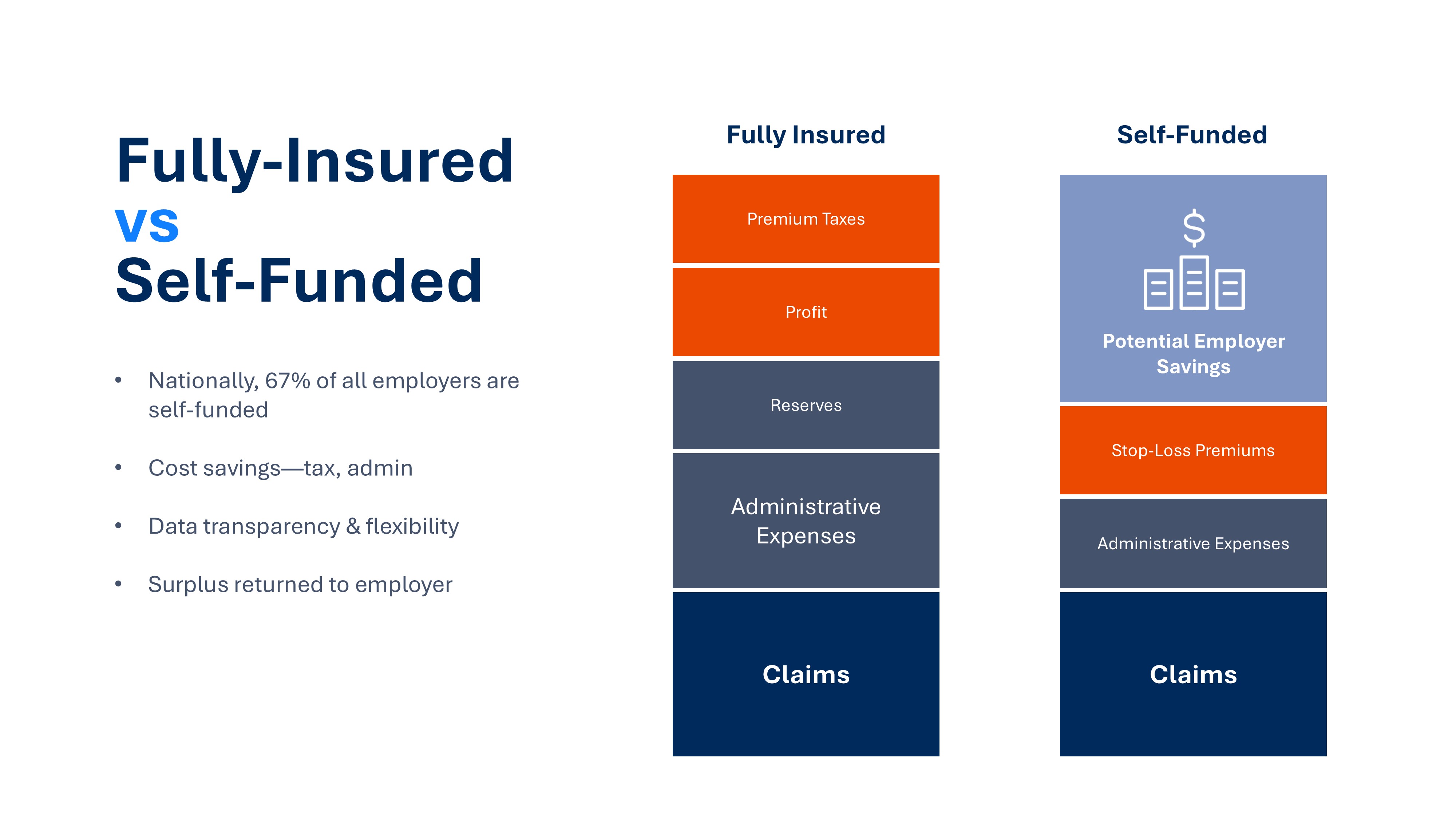 Chart courtesy of Benecon
Funding Model Decision Considerations
Self-funding is not a one-size-fits-all solution, as employers need sufficient scale and claims volume to make the transition viable. The comparison below highlights a few key differences between fully insured and self-funded insurance. Note that self-funding typically becomes a viable, cost-effective strategy as companies grow while fully insured plans often remain the only option for small businesses.
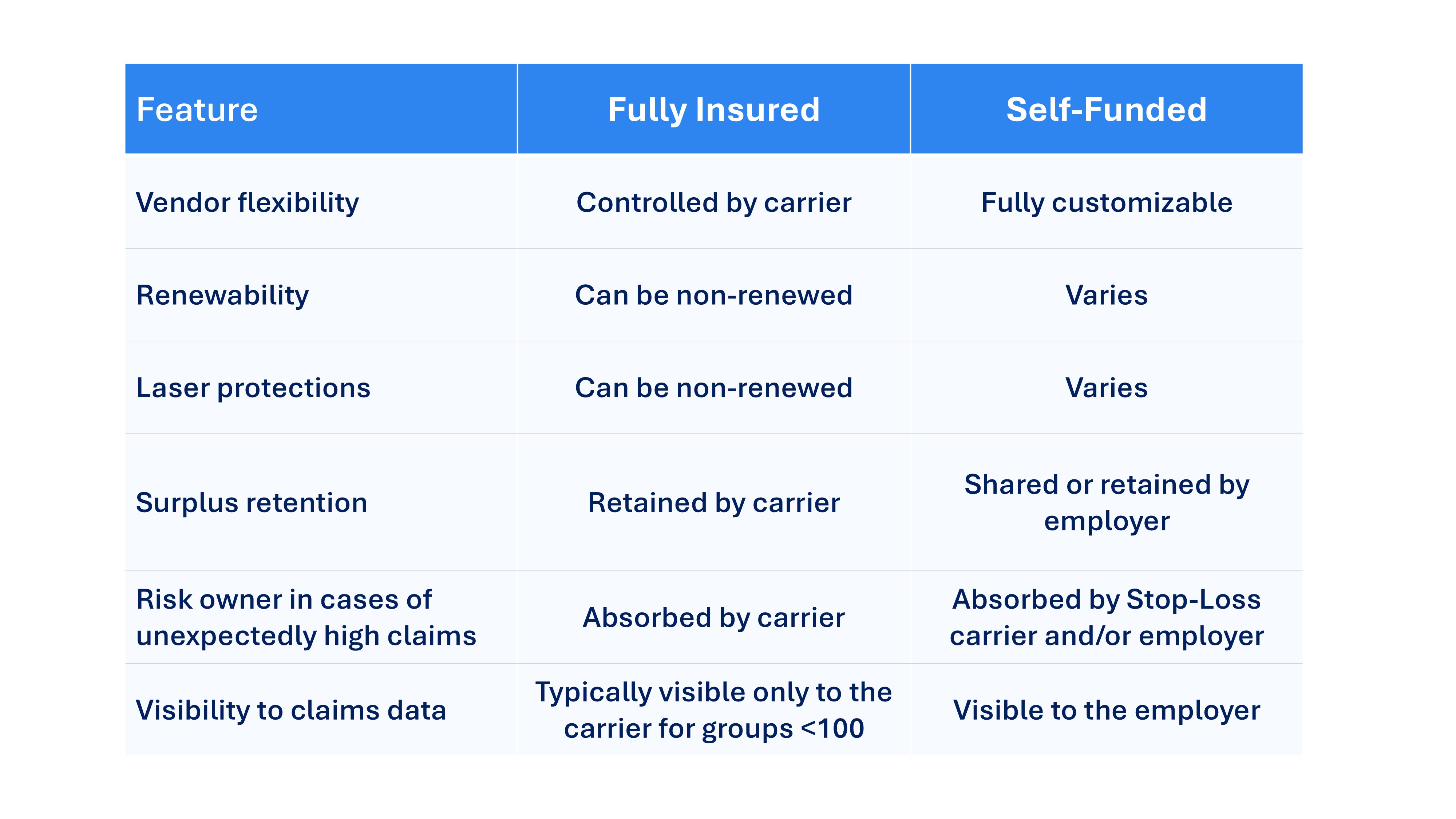 Chart courtesy of Benecon
Any health care insurance decision should be a careful, nuanced discussion with a knowledgeable broker. Nonetheless, company size is often the first criteria a company must consider. Most states have mandated minimum number of employees for stop-loss coverage, a critical element for safely self-funding. Either choice has federal compliance requirements and employers should work with their brokers to understand the compliance.
Not all self-funded structures are built the same. Differences cover operations, financial exposure, and administrative workload. Organizations assessing their readiness should compare traditional fully insured plans against stand-alone self-funding, level-funding, captives, and independent consortium models. Each option, with its own pros and cons, fits some companies but not others. For example, mid-to-large-sized employers seeking predictability without committing collateral or taking on volatile stop-loss renewals, find that an Independent Consortium Model combines the underwriting scale of a larger pool with the financial autonomy of traditional self-funding.
Key Stakeholders in a Self-Funded Plan
When an organization steps away from fully insured coverage, it replaces a single insurance carrier with a coordinated ecosystem of independent service providers. Understanding each party’s role ensures smooth administration and governance.
- Employer: Acts as the primary fiduciary, financial backer, and legal authority of the health plan. Rather than paying fixed monthly premiums to a carrier, the employer assumes direct stewardship over healthcare strategy, selects administrative partners, approves plan design, and funds actual employee claims.
- Employee Benefits Broker/Advisor: Serves as the primary strategist, assisting with market analysis, stop-loss procurement, vendor evaluation, and ongoing plan governance. The broker will often provide the employer with options for several plan designs. Sometimes the options are from different Third-Party Administrators (TPAs) and offer a different mix of services and pricing.
- Third-Party Administrator (TPA): Handles claims processing, plan documentation, customer service, and regulatory compliance reporting (such as ERISA and HIPAA guidelines enforced by the U.S. Department of Labor Employee Benefits Security Administration). The TPA arranges for the health network which in turn delivers contracted discount rates for hospital, physician, and pharmacy services.
- Stop-Loss Insurance Carrier: Provides catastrophic financial protection by reimbursing claims that breach pre-determined specific or aggregate thresholds.
- Pharmacy Benefit Manager (PBM): Manages prescription drug formularies, processes pharmacy claims, and negotiates manufacturer rebates. In self-funded plans, employers can choose transparent, pass-through PBM arrangements rather than traditional spread-pricing models.
- Consortium / Captive: Helps neutralize volatility and strengthen predictability.
What Changes for Employees?
A common misconception among HR leaders is that transitioning to self-funded health plans creates confusion or operational friction for plan members. When structured properly, the employee experience remains entirely seamless or even improves.
- Card and Network Familiarity: Employees typically receive standard member ID cards featuring recognized national or regional provider networks. Provider access remains identical.
- Tailored Plan Design: Employers gain the flexibility to customize deductibles, copays, wellness incentives, and Health Savings Account (HSA) integration due to exemptions around many state insurance benefit mandates.
- Carved-In vs. Carved-Out Pharmacy Benefits: Employers can maintain integrated pharmacy access or introduce high-touch specialty pharmacy stewardship programs that reduce out-of-pocket costs for specialty medications.
- Enhanced Advocacy Services: Self-funded structures often integrate independent healthcare navigation desks and clinical advocacy resources to guide members through complex procedures.
- Leveraging Data: Access to the data in a self-funded plan allows consultants and employers to leverage design, network, cost-containment, and other tools to maximize the most high-quality and cost-efficient care.
Implementation Roadmap: Strategic Timeline for a January 1st Plan Date
Successfully executing a self-funding transition requires a disciplined cadence. Below is a typical operational roadmap for employers targeting a January 1 effective date:
- May – August – learn about market options: Brokers may suggest presentations from a limited group of alternative options.
- September (Feasibility Analysis): Collect 24-36 months of detailed claims data (for groups larger than 100 members) or census data for feasibility (for smaller groups).
- September – October (Market RFPs): Issue requests for proposals (RFPs) across TPAs, PBMs, stop-loss carriers, and consortium networks to compare fixed administrative costs and policy terms. Many times, starting with a consortium network will result in selecting RFPs together.
- October – November (Underwriting & Finalization): Finalize stop-loss underwriting, lock in specific and aggregate deductibles, and confirm laser protections. The employer decides on the appropriate risk and cost and providers, working with the broker to finalize the selection.
- November (Open Enrollment & Communication): Conduct employee open enrollment sessions, highlighting plan enhancements, telehealth tools, and wellness initiatives.
- December (Systems Setup & Onboarding): Issue new ID cards, complete plan document drafting, and complete TPA claims feed integrations.
- January 1 (Effective Date): Transition to the self-funded plan with active monthly financial tracking.
Action Plan for Benefits and HR Leaders
For employers reassessing their healthcare financing options, moving beyond reactive renewals requires a structured, multi-step review process. You must consider these steps:
- Gather Current Data: Request complete claims utilization reports, large claims reports, and pharmacy summary reports from your current carrier to assess your baseline transparency, and aid in the RFP process.
- Evaluate Alternative Risk Structures: Request a side-by-side financial and long-term risk analysis comparing stand-alone self-funding, captive models, and independent consortium models against your current fully insured baseline.
- Establish a Multi-Year Horizon: Treat health plan funding as long-term financial strategy rather than an annual shopping task. This may be a major shift in how you offer benefits.
By taking a proactive, data-driven approach, you can build sustainable employee benefit strategies that deliver capital protection, long-term budget predictability and transparency over your costs. If self-funding sounds appealing, consider the range of options from going on your own to being part of a group, such as a captive or consortium. Make sure you have some risk protection with stop loss. Ask your benefits consultant for an overview and consider inviting an expert from the different funding options for a deeper dive.
Tim Kinnicutt, Sales Director, New England for Benecon
[email protected]
Benecon offers the BeneBlog for self-funding expertise, including MasterClass sessions, industry compliance updates, and more. Another resource is SIIA, the Self-Insurance Institute of America.